Showing posts with label los angeles. Show all posts

Monday, July 25, 2011

Review A Dozen Deadly Rose


Review A Dozen Deadly Roses by Kathy Bennett

Web Site
Blog

This novel is Ms Bennett's first published. And it's a good beginning. A Dozen Deadly Roses is a romantic suspense. LAPD officer Jade Donovan is a field training officer. But when she finds out who the ‘rookie' riding with her will be, she knows she's in trouble. Mac Stryker was her training officer. He was also a drunk who nearly got them both killed. A mistake lands Jade in Mac's bed. She is left pregnant and Mac leaves the force, never knowing he had a son.

Now he's back and Jade just knows he's going to be trouble. She is torn between telling him about his son and maybe having to face his claims as a father. Stryker might be sober, but can he stay that way? Jade knows first hand how easy and often reformed drunks can fall back into the bottle.

As if that isn't enough, someone is stalking her. It starts with a gold box being delivered, filled with a dozen dead roses. The next day the same shows up on her doorstep, this time with eleven dead roses. It quickly becomes clear the threat is bad. Jade doesn't want her division to know what's going on. She'll tackle it herself. Her determination starts a train of events that will see her facing a killer and maybe losing everything--her life, her son's and Stryker's love.

I really enjoyed this book. I'm glad to hear the author plans more. Her characters are well developed and likable--or unlikeable as the case may be--and I know I was rooting for Jade and Stryker. If you like cops, suspense and romance, then this is the book for you. You won't be disappointed.

Sunday, July 17, 2011

Great Icons... and then there's Los Angeles


What icon comes to mind when you hear the name New York City? For me it's the Statue of Liberty. Others might think of the Empire State Building. What about Paris? The Eiffel Tower. London? Buckingham Palace. San Francisco? The Golden Gate Bridge. Egypt? The pyramids. The Sydney Opera House. The Great Wall of China, Mount Rushmore, the Taj Mahal...

All great monuments of their time that stand for ingenuity, craftsmanship and the indomitable spirit of mankind and our artistic skills.

Now think Los Angeles. I would hazard a guess that what pops to mind is Hollywood and the Hollywood sign or Graumann's Chinese Theater. Vast monuments? Skillfully designed edifices that strikes awe into people when they first see it?

No, a nearly century old advertising gimmick to sell lots in a city that was promoting growth. Harry Chandler, publisher of the Los Angeles Times, along with other wealthy Californians, was also a land speculator. He promoted the growth of Los Angeles, the Valley and of course, Hollywood. The sign meant to help him and the other investors to get richer went up in 1923 at the cost of $23,000. The LAND part of the sign was removed in 1949. It was fixed and made more permanent in 1978. In 2005 the metal sign was stripped and repainted white.

I guess in terms of monuments, it beats a giant donut.

This is part of why I love L.A. It's not like anyplace else. Where else would pocket dogs be created. Where pet rocks actually became a craze. (I had a pet rock, but I didn't buy him in some store, I caught him myself, up in the hills and I had to break him all by myself) Where people throng from all over the world to see the hand prints or foot prints of men and (and the odd animal) they only know through the screen. Where even the cops are good looking. Where some east coast exiles came with a few black and white, grainy moving pictures and created a multi-billion dollar enterprise that has shaped beliefs and societies.

Wednesday, November 24, 2010

The Chinese Massacre of 1871

The transcontinental railroad finally reached Los Angeles and mong the other immigrants to arrive on it were the Chinese. They settled in an older area of L.A, away from the Anglos and set up laundries, restaurants and gambling places. In that area was a 500 foot ‘alley’ called the ‘wickedest street on earth’. It was also called Calles de los Negros since many of the residents were the darker-skinned mestizos, Indians and half-breeds. Colloquially, it was called Nigger Alley. It averaged a homicide a night and that tally didn’t include Indians. It was home to brothels, saloons and adobe and wood hovels filled with the dregs of the city. In later years it was renamed and became part of North Los Angeles Street.

On October 26 or 27th a battle between two tongs erupted. When some sheriffs and other Anglos attempted to break up the fight, one of them, a rancher Robert Thompson was killed in the cross-fire.

In his first person account of the Chinese Massacre of 1871, recorded, “News of the attacks and counter-attacks spread like wild-fire, and a mob of a thousand or more frenzied beyond control, armed with pistols, guns, knives and ropes, and determined to avenge Thompson's murder, assembled in the neighborhood of the disturbance.” This mob embarked on a frenzy of lynching, shooting, stabbing and looting every Chinese man they encountered.

In his own words, Newmark said, “Besides Judge Widney, Cameron E. Thom and H. C. Austin displayed great courage in facing the mob, which was made up of the scum and dregs of the city; and Sheriff Burns is also entitled to much credit for his part in preventing the burning of the Chinese quarters. All the efforts of the better element, however, did not prevent one of the most disgraceful of all disturbances which had occurred since my arrival in Los Angeles.”

By morning, 19 Chinese men were laid out on the street near city hall, some still had the ropes they had been hung with around their necks. At the coroner’s inquest it was determined that only 1 of the men had been involved in the original tong war. Around 111 witnesses were called to testify before the Grand Jury. Blame for the incident was originally put on the police for not moving in and controlling the mob sooner. At the time a state law forbade a Chinese man from testifying against an Anglo.

There were 49 men indicted for the deadly attack, 23-25 men were charged with murder or incitement to murder and 7 were found guilty. They were given sentences between 2 and 6 years. The sentences were later over turned on appeal and the blame was shifted to the Chinese for not alerting the authorities sooner.

Newmark concluded with, “Following this massacre, the Chinese Government made such a vigorous protest to the United States that the Washington authorities finally paid a large indemnity. During these negotiations, Chinese throughout the country held lamentation services for the Los Angeles victims; and on August 2d, 1872, four Chinese priests came from San Francisco to conduct the ceremonies.”


Harris Newmark (1834-1916), son of a modest Prussian Jewish merchant, who arrived in America in 1853 and joined his older brother in Los Angeles.

Ref: American Memory. Sixty years in Southern California, 1853-1913, containing the reminiscences of Harris Newmark. Edited by Maurice H. Newmark; Marco R. Newmark: CHAPTER XXIX THE CHINESE MASSACRE 1871


L.A. El Pueblo Grande by John Weaver, the Ward Ritchie Press, Pasadena, 1973

Friday, June 25, 2010

Black Widow Louise Peete


Lofie Louise Preslar, born in Bienville, Louisiana, a very personable woman who people loved. She was also one of America's leading "black widows". She was the Southern Belle daughter of a wealthy newspaper publisher. She attended the best private schools in New Orleans, where she became notorious for her sexual escapades which got her expelled. Following that illustrious beginning she embarked on a life of pleasure and murder.

She married traveling salesman Henry Bosley in 1903, and traveled with him. In the summer of 1906, Henry caught his wife in bed with a local Texas oilman and grief-stricken, killed himself two days later. Louise sold Henry's belongings and moved to Shreveport, where she worked as a prostitute until she could afford a trip to Boston. There she continued as a prostitute. She became popular as a girl who would make house calls. But on the side she lifted the jewelry of the wives of her wealthy clients. Eventually her larceny was discovered and she fled to Waco, Texas. There she met Joe Appel, another wealthy oilman, a flamboyant character who wore diamond studded rings, belt buckle and even the buttons on his clothes.

One week after they met, Joe was found dead with a bullet in his head. His diamonds were missing. Called before a special grand jury, Louise admitted shooting Appel down - in "self-defense." The oil man tried to rape her, she claimed, and she was forced to defend herself. The missing jewels forgotten, members of the jury applauded her. They also set her free.

By 1913, running out of luck and money, Louise married local hotel clerk Harry Faurote. Her flagrant adultery soon drove Faurote to hang himself. Moving to Denver in 1915, Louise then married Richard Peete, a door-to-door salesman. She bore him a daughter in 1916, but Peete's meager income wasn't up to her standards, and she took off alone, for Los Angeles, in 1920.

Shopping for a house to rent, Louise met mining executive Jacob Denton. Instead of leasing her the house, she persuaded Jacob to retain the property, and Louise would come in as a live-in companion. After several weeks Denton refused to marry her. In response, Louise ordered Denton's caretaker to dump a ton of earth in the basement saying she planned to "raise mushrooms" - Denton's favorite delicacy - as a treat for her lover.

Denton disappeared on May 30, 1920. There never were any mushrooms. Louise had numerous explanations for curious callers. First, she told all comers that Jacob had quarreled with "a Spanish-looking woman," who became enraged and chopped his arm off with a sword. Although he managed to survive, she said, poor Jacob was embarrassed by his handicap, and had gone into seclusion. Pressed by Denton's lawyer, she revised the story to include an amputated leg; the missing businessman would return once he was comfortable with his artificial limbs.

Most incredibly, these tales kept everyone at bay for several months, while "Mrs. Denton" threw a string of lavish parties in her absent lover's home. It was September by the time Denton's lawyer grew suspicious enough to call the police to search the house. An hour's spade work turned up Denton's body in the basement, with a bullet in his head.

Detectives started hunting for Louise, and traced her back to Denver, where she had resumed a life of wedded bliss with Richard Peete. Convicted of a murder charge in January 1921, Louise was sentenced to a term of life imprisonment. In the beginning, Richard corresponded regularly. In 1924, when several of his letters went unanswered, Peete committed suicide.

San Quentin's warden, Clinton Duffy, once described Louise Peete as projecting "an air of innocent sweetness which masked a heart of ice." Apparently she liked to boast about the lovers she drove to suicide, especially cherishing Richard's suicide, proof that even prison walls couldn't contain her fatal charm.

In 1933, Louise was transferred from San Quentin to the prison at Tehachapi, and six years later on her tenth attempt to win parole, she was released.

Her release was due to the intercession of a social worker, Margaret Logan, and her husband Arthur. Paroled to the care of a Mrs. Latham, in Los Angeles, Louise was allowed to take the name "Anna Lee," after her favorite movie star.

She found employment at a servicemen's canteen in World War II; in 1942, an elderly female co-worker vanished inexplicably, her home discovered in a state of disarray. Detectives called on "Anna Lee," the missing woman's closest friend, and they were told the woman had died of injuries sustained in a fall. The police bought the story, never bothering to check out "Anna's" background or obtain a death certificate.

The kindly Mrs. Latham died in 1943, and Louise's parole went to the Logans. She married elderly bank manager Lee Judson in May 1944, and on May 30, Margaret Logan vanished without a trace, Louise telling Margaret's aged husband that his wife was in the hospital, unable to receive visitors. By late June, Louise persuaded the authorities that Arthur Logan was insane and he was committed to a state hospital, where he died six months later. With typical lack of feeling, Louise donated his body to a medical school for dissection.

Louise moved into the Logan home with Judson, but in short order, her husband discovered a bullet hole in one wall, a suspicious mound of earth in the garden, and an insurance policy naming Louise as Margaret Logan's sole beneficiary. He never told anyone.

By December 1944, Louise's parole officer had grown suspicious of the regular reports, submitted over Margaret Logan's shaky signature, that contained such glowing praise for their charge. Police invaded the Logan home shortly before Christmas, prompting Lee Judson to voice his suspicions at last. Margaret Logan's body was unearthed in the garden, whereupon Louise offered another of her patented fables. In this story, decrepit Arthur Logan had gone suddenly insane, beating his wife to death in a maniacal rage. Terrified of attracting suspicion due to her background, Louise had buried the corpse and stalled for a month before having Arthur committed to an asylum.

Louise was charged with Margaret Logan's murder, her husband booked as an accessory. Acquitted on January 12, 1945, Judson took his own life the next day, leaping from the thirteenth floor of a Los Angeles office building. Louise, it was observed, seemed pleased with his reaction to their separation.

Convicted of first-degree murder by a jury that included eleven women, Louise was this time sentenced to die. Her appeals failed, and she was executed in San Quentin's gas chamber on April 11, 1947.

Evil Diva

Time Monday, Jun. 11, 1945

Thursday, June 3, 2010

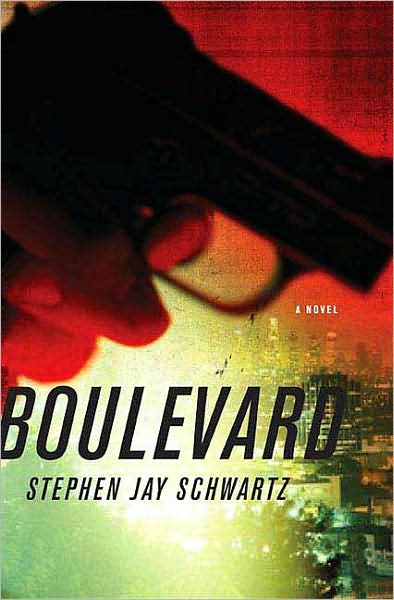
Review of BOULEVARD


Stephen Jay Schwartz

Sometimes a debut novel comes out that just blows you out of the water. Or as a writer myself, one I wish I had written.

I'm always on the look out for new books set in Los Angeles. I'm a noir reader who likes dark fiction and I've found few places that lends itself to that more than the city of Angels. Having lived there eight years I have personal experience with the dichotomy of the place. At once filled with glitter and glamor, it is also home and birthplace of many of the most violent gangs in North America, if not the world. From the days of Raymond Chandler and Ross MacDonald writers have explored the dark side of this fascinating city.

It's hard to think of Los Angeles without thinking about the LAPD. The police force of Los Angeles has always had a big role in the character of the city, from the boundless corruption in the early part of the 20th Century to the violence and riots that threatened to tear the city apart. Even today there is a simmering tension in the dark Angel.

In Boulevard we meet one of the members of the thin blue line, LAPD homicide detective Hayden Glass, who's a member of the elite Robbery Homicide division that handles all the high profile murders. But Hayden has a secret he's desperate to keep -- he's a sex addict who cruises the very boulevards he's supposed to be policing, picking up street walkers and going to massage parlors for sex. His marriage fell apart because of his addiction. But now he might not be able to keep his secret much longer. Someone is targeting people Hayden knows and only he sees the connection in the victims, since he can't reveal his addiction which is what ties them together.

An excellent novel. Schwartz is a wonderful new voice in dark Los Angeles fiction and I can't wait to read more from this up and coming author.

Thursday, May 27, 2010


El Pueblo de Nuestra Senora la Reina de Los Angeles. Los Angeles. The wild, wild west indeed. Before the city, there was the 'hell hole of the west', the most violent place at the end of the Pacific Special. The place where everyone went when they had no place else to go. When you were driven out of everyplace else, you went west, just like Horace Greeley told you to. And once you hit Los Angeles that was the end of the road.

Los Angeles always attracted the outcast, the misfit, people on the run and people seeking change. There's never been anything normal or ordinary about the city of Angels or the people who inhabit it.

The first law in L.A. was a volunteer group of men who formed the Los Angeles Rangers in the early part of the nineteenth century. Unpaid, they lived off the largess of others for their equipment. The unit lasted roughly four years, then disbanded, leaving the already violent Los Angeles without a police presence. The county was overrun with bandits, gamblers, murderers and rustlers driven south by northern vigilantes. Vice of all kinds was not only legal, it was taxed.

To fill the void, the Vigilance Committee was formed in 1836. On October 13, 1854 Pinckney Clifford, a prominent businessman, was robbed and murdered by David Brown, a well-known bandit. The city Marshall jailed Brown, but the Vigilance Committee intended to take care of the killer. Mayor Stephen Foster intervened and convinced them to wait for the trial. But though convicted and sentenced to hang in January 12, 1855, his attorney convinced the California Supreme Court to grant a stay of execution. Instead another convicted murderer, a half-breed Indian was hanged.

Now provoked beyond reason, the Vigilance Committee, led by Mayor Stephen C Foster (who resigned his position to lead the lynch mob) forcibly removed Brown from his cell and hanged him. When Foster ran for re-election he was voted back in as Mayor on a landslide. Only in Los Angeles, you say? L.A. was also the first major metropolitan city to recall a Mayor from office, but that, as they say, is another story.